Sugiura Yasuyoshi
Sugiura Yasuyoshi — Decorative Ceramic Sculpture "Deutzia Fruit" Museum-Quality Botanical Art Object (Sold)
Sugiura Yasuyoshi — Decorative Ceramic Sculpture "Deutzia Fruit" Museum-Quality Botanical Art Object (Sold)
Couldn't load pickup availability
This piece has found its home. It is kept here as a record of what has passed through our hands.
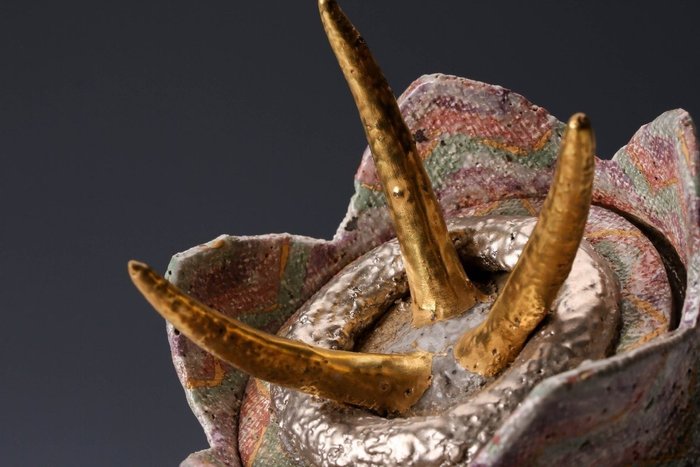
This is an exceptional piece from the acclaimed "Ceramic Natural History (Tōhakubutsushi)" series by Sugiura Yasuyoshi (, born 1949-), titled "Deutzia Fruit (Utsugi no Mi)".
This remarkable work exemplifies Sugiura's masterful ability to capture nature's intricate forms through the medium of ceramics.
Sugiura Yasuyoshi is renowned for his extraordinarily realistic ceramic sculptures that blur the boundary between art and natural science.
His "Ceramic Natural History" series represents a unique fusion of botanical accuracy and artistic expression, creating three-dimensional studies of plant forms that rival scientific illustration in their precision while maintaining profound aesthetic beauty.
Born in Tokyo's Katsushika ward in 1949, Sugiura graduated from Tokyo University of the Arts (Tokyo Geidai) Graduate School in 1975, specializing in ceramics.
Rather than following conventional paths in the ceramics world, he chose to work independently, developing a distinctive artistic voice that sets him apart from traditional pottery and functional ware.
In 1979, he made his mark with "Stone Groups in Ceramics" at Kaneko Art Gallery, and in 1984, he established his kiln in Manazuru, Kanagawa Prefecture, where he continues to work.
His innovative approach has garnered national attention, including features on NHK's "Studio Visit - Creating" (1990) and "Ceramics Exploration" (1999).
This particular piece, "Deutzia Fruit," captures the delicate seed pods of the Deutzia (Utsugi) plant with astonishing botanical accuracy.
The Deutzia, a flowering shrub native to East Asia, produces distinctive capsular fruits that Sugiura has rendered in exquisite detail.
Every subtle texture, every organic curve, and every natural imperfection has been meticulously observed and translated into ceramic form.
What distinguishes Sugiura's work is not merely technical virtuosity, but his philosophical approach to nature.
His pieces invite contemplation of natural forms we might otherwise overlook, transforming the ephemeral into the permanent through the ancient medium of fired clay.
Each work in the "Ceramic Natural History" series functions as both sculpture and scientific specimen, challenging our perceptions of what ceramics can achieve.
The piece comes with its original artist-signed wooden box (matching the artist's signature), display card (tate-fuda), and protective cloth (tomogire), confirming its authenticity and provenance.
It remains in flawless condition - a testament to both its craftsmanship and careful preservation.
This work represents an important example of contemporary Japanese ceramic art that transcends traditional categories, appealing to collectors of both fine art and natural history.
Size
Height: 11.5 cm
Width: 9.5 cm
Depth: 9.5 cm
Condition
Flawless condition with no damage. The piece displays exceptional preservation of fine details.
Artist Profile
Sugiura Yasuyoshi (born 1949) is a distinguished contemporary ceramic artist celebrated for his hyperrealistic sculptural works that document natural forms with scientific precision and artistic sensitivity.
Born in Katsushika, Tokyo, Sugiura pursued formal training in ceramics at Tokyo University of the Arts, completing his graduate studies in 1975. From the outset of his career, he chose to work outside the traditional craft association system, allowing him complete artistic freedom to develop his unique vision.
Artistic Philosophy and Approach:
Sugiura's work represents a radical departure from conventional ceramic practice. Rather than creating functional vessels or traditional decorative objects, he uses clay as a medium for capturing transient moments in nature's cycles. His "Ceramic Natural History" series transforms botanical specimens into permanent sculptural forms, creating a dialogue between art, science, and nature.
His process involves meticulous observation of natural subjects, often spending extended periods studying plant structures, rock formations, and organic textures before translating them into clay. The resulting works possess an uncanny verisimilitude that can surprise viewers who initially mistake them for actual natural objects.
Selected Career Highlights:
1975: Graduated from Tokyo University of the Arts Graduate School (Ceramics)
1977: Selected for Japan Ceramic Art Exhibition
1978: Japan International Ceramics Exhibition (Daimaru)
1979: "Stone Groups in Ceramics" exhibition at Kaneko Art Gallery (career-defining presentation)
1982: Contemporary Japanese Ceramics Exhibition (Japan Foundation, toured Italy)
1984: Established kiln in Manazuru, Kanagawa Prefecture
"Stone Groups in Ceramics" at Lake Biwa Contemporary Sculpture Exhibition
1985: 4th Henry Moore Grand Prize Exhibition
1990: Featured on NHK's "Studio Visit - Creating" television program
1994: "Ceramic Grove" solo exhibition at Kaneko Art Gallery
"Ceramic Grove: Forest Space - Organic Space" (Aichi Prefectural Ceramic Museum)
1995: Solo exhibition at Kando-ri, presenting colored pattern vessels
1997: "Sugiura Yasuyoshi: Ceramic Rocks, Ceramic Groves" (Kirin Yokohama Beer Village)
2000: Solo exhibition at Nihombashi Mitsukoshi, featuring objets inspired by nuts, fruits, and still life
2005: "Celebrating Earth's Bounty in Ceramics: Natural Breath and Form" (Kanagawa Prefectural Hall Gallery)
2006: "Ceramic Botanical Garden" (Suntory Museum of Art, Chiyoda)
"Wind Screen" (Echigo-Tsumari Art Triennial)
2007: 14th Japan Contemporary Art Promotion Award (Japan Culture and Arts Foundation)
2009: "Wind Fort" (Echigo-Tsumari Art Triennial)
2012: "West African Sojourn" (Kando-ri)
Artistic Significance:
Sugiura's work occupies a unique position in contemporary Japanese ceramics. While maintaining deep respect for traditional materials and techniques, he has pioneered an entirely new vocabulary for ceramic art - one that engages with natural science, environmental awareness, and philosophical questions about permanence and transience.
His "Ceramic Natural History" series, to which this "Deutzia Fruit" belongs, represents perhaps his most iconic body of work. These pieces function simultaneously as:
Precise botanical documentation
Meditations on natural beauty
Explorations of ceramic's unique properties as a preservation medium
Commentaries on humanity's relationship with the natural world
Unlike traditional nature-inspired ceramics that stylize or interpret natural forms, Sugiura's approach emphasizes faithful representation while never losing sight of the work's identity as a handmade ceramic object. This tension between realism and artifice creates a compelling aesthetic that has influenced a generation of ceramic artists.
His independent stance - working outside craft guilds and art associations - has allowed him to pursue this singular vision without compromise, establishing him as one of contemporary Japan's most innovative and respected ceramic artists.
NOITICE:
The lot will be carefully packaged and sent by Japan Post, DHL or FedEx depend on the situation.
It takes about 3 weeks to receive normally.
Import duties, taxes, and charges are not included in the item price or shipping cost.
These charges are the buyer's responsibility.
Sometimes Customes or delivery company in your country contact you for Customs clearance via phone or email. Please make sure that you could answer the phone. If you don't, the parcel will return to me and it cost more double shipping fee for reshipping.
I appreciate your cooperation.
Sold — no longer available.
Share